A studio manager I met in October puts together a report every week on attendance, who’s left, new members and what to do in the week ahead. The owner had told me earlier in the month that it takes at least an hour a week and it’s all done by hand.
That’s the people side of a health check and it’s where next year shows up first, in who’s booking and how often and whether this year’s new members are still around. A full check looks at the classes and the money as well.
Five things worth looking at
Each of these is something you can check yourself in your booking system or your accounts. For the counts and the money, compare with the same month last year rather than last month, because January against December mostly tells you about the holidays.
Who’s coming, and how often
Count how many different clients came to at least one class last month and how many visits they made between them then divide the visits by the clients. The first number is whether you’re growing. Visits per client is whether the people you already have are still in the habit and it can slip while the first one climbs.
Worked example: Riverside, a demo studio
Riverside is the demo studio I use to show Studio Signal, so its clients and visits are invented. This is September against the September before.
| Sept 2025 | Sept 2026 | |
|---|---|---|
| Clients who came in | 95 | 141 |
| Visits | 415 | 534 |
| Visits per client | 4.4 | 3.8 |
Riverside is having a good year. 46 more clients came in than the September before and sales through the booking system more than doubled. Visits per client went the other way though, down from 4.4 to 3.8, so the people already coming are in a bit less often.
None of that is a problem on its own. At Riverside the drift check below is the one I'd do first.
New clients, and whether they stick past the first month
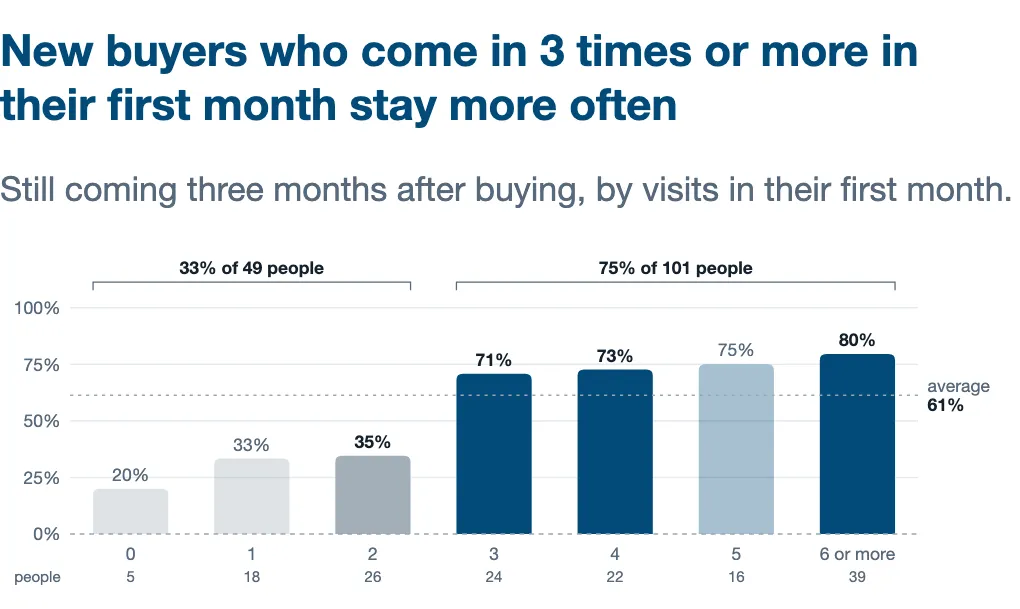
Take everyone whose first class was two to three months ago and count how many came back at least once in their second month. Someone still coming in month two has started to fit you into their week. How often they came in their first month is a good early sign of who will get there. The ones who stopped after a visit or two are easier to reach while they’re new than six months later.
Who’s drifting
Your regulars don’t all come the same amount, so the check is against each person’s own normal. Write down roughly how often each of your 20 most regular clients usually comes and look for anyone now past double that gap. Leave out anyone who is on hold with a date to come back, because they haven’t left.
Which classes earn their place
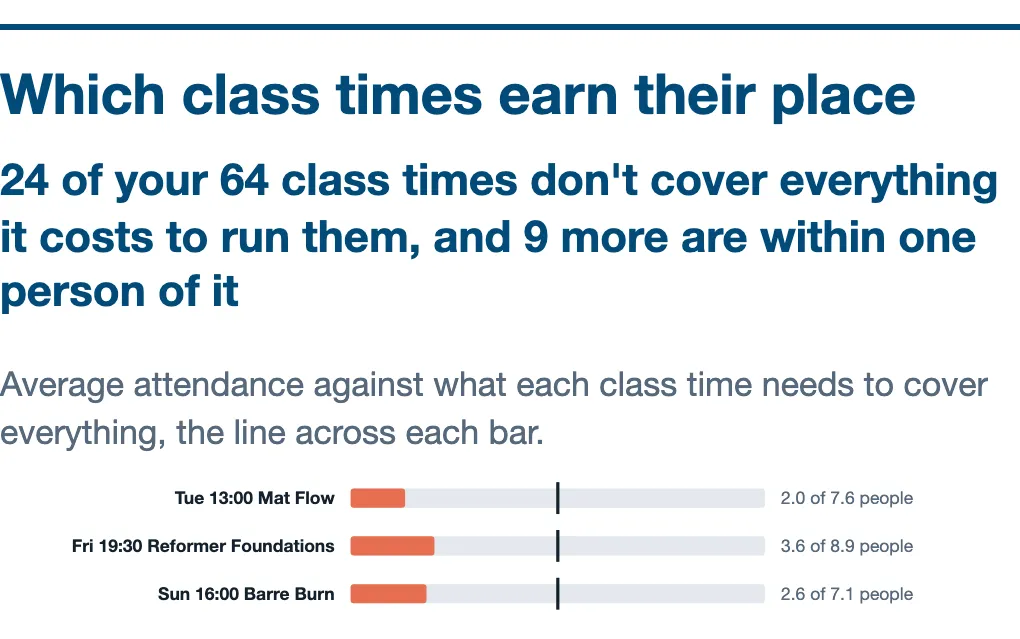
For each class time, take the average number in the room over the last couple of months and compare it with how many people it takes to pay whoever is teaching it. That second number is the instructor’s pay for the class divided by what a client pays you per visit, worked out from what your members actually pay, not the casual price. A class short of it might still be worth running if it’s where a lot of new clients start, but it’s the first to look at before the next timetable change. Is this class worth keeping goes through it properly and the class calculator does the sums for you.
Money in and money out
From your accounts, put the last three months of revenue next to every cost: rent and wages but also software, ads, cleaning and what you pay yourself. Three months smooths out the lumpy bills that make one month look expensive, like the ones that land once a quarter. Then compare it with the same three months last year.
Leave your own pay out and the business can look healthier than it is. Studio Signal is a sole-trader business, so what I take out of it never shows up as a cost in its books and the only way to see whether it pays me is to add that figure in myself.
How often to look
The people side suits a weekly look, the way that studio manager does it, because a new client or a regular going quiet is worth a note this week and not next month. The money reads better monthly or quarterly, because one week of revenue swings around with when people happen to buy a pack and a bad week can make everything look worse than it is.
Whichever rhythm you pick, ask the same questions each time against the same comparison, so the numbers mean something next to the last lot.
Where the growth comes from
Each check points at something you can grow. A studio grows when more new clients arrive and more of them make it past their first month, when regulars come a little more often and stay longer and when the timetable puts classes where people want them. The checks tell you which of those is weakest right now and that’s the one to work on first.
At Riverside the number of clients is climbing and visits per client has slipped. Getting back to last year’s rate across its 141 clients would be about 80 more visits in a month without a single new client, so the drift list and the regulars are worth more of its attention than another intro offer. A studio with the opposite picture, loyal regulars and few new faces, would put the effort into bringing people in and getting them to their third visit.
What a deep dive adds
Some of it is hard to do by hand, like following every new client for a year or working out what each class time costs once rent and everything else is shared across the timetable.
When a studio comes on to Studio Signal I send the owner a deep dive built around the questions they brought to our first call. One I sent a yoga studio owner in October started with how her year was going and then went to the members she’d told me were dropping off, counted the way she counts them, as people on a membership or a pack that renews automatically.
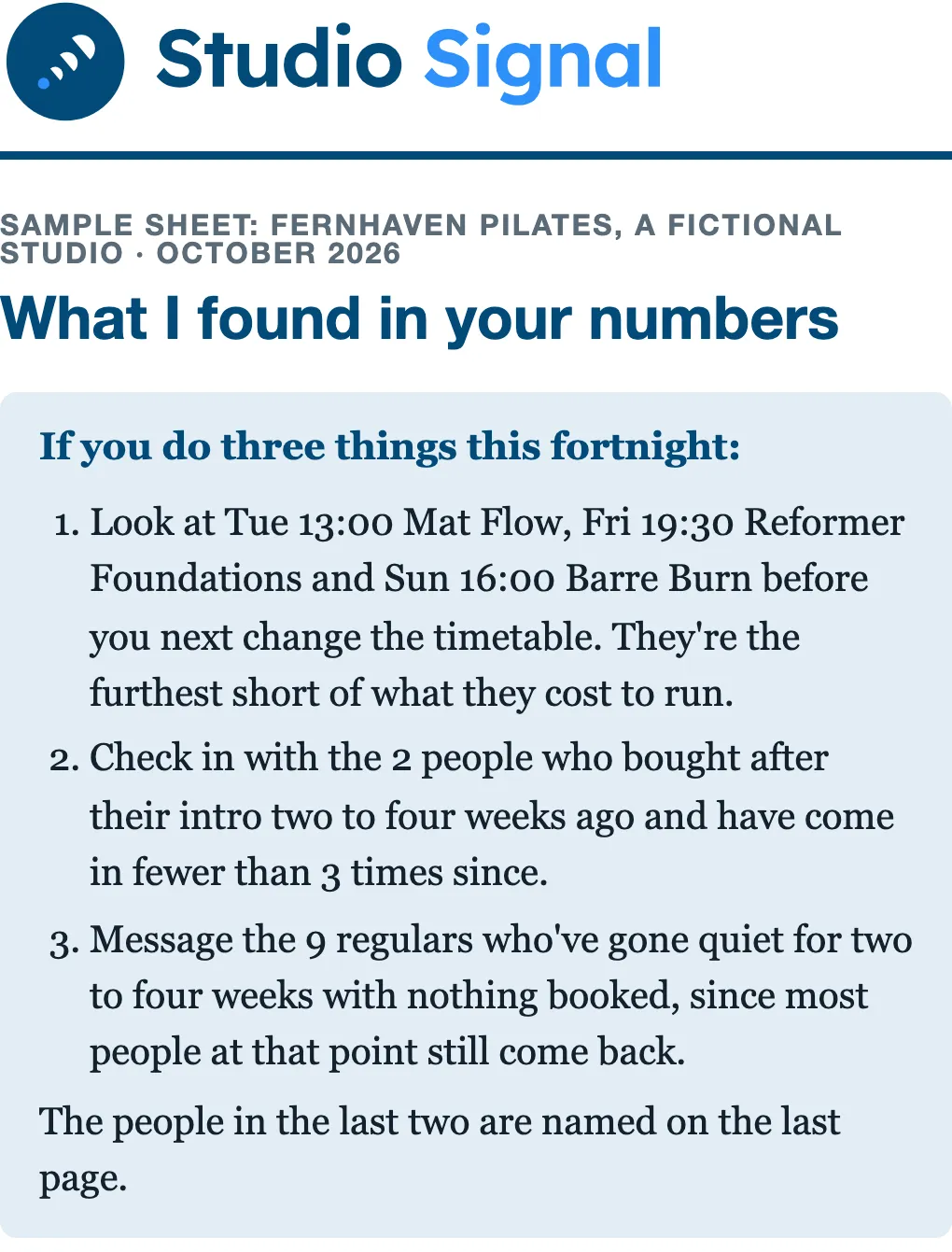
On a sample I wrote for a studio I made up, about 1 in 7 new members stopped coming between six months and a year in. By then most owners have stopped thinking of them as new. A few pages from that sample are below.