Most of what gets written about retention is about stopping people leaving and I’ve written about spotting who’s slipping away myself. The other half happens long before anyone drifts. People stay at a studio when coming in has become part of their week and when the people there know them. Both are things a studio can make a lot more likely.
Start with the first three months
A new client hasn’t got a routine with you yet. They’re fitting you in around everything else and a busy fortnight is all it takes for them to stop.
There’s research on how long that routine takes to form. In a 2010 study, 96 people each picked something to eat, drink or do every day at the same point in their day, such as after breakfast. For the people whose results could be modelled it took anywhere from 18 days to 254 for it to become automatic. What built the habit was repeating it in the same context and missing a single day made little difference.
For a client that means the same class at the same time each week, ideally with the same instructor and the same faces around them. Missing a week is fine as long as there’s a regular class to come back to.
What helps in those first weeks:
- Book the next class before they leave. A client who walks out with Thursday 8am already in the calendar has made the decision once instead of every week.
- Introduce them to someone. The instructor learning their name and one other client saying hello is most of what makes a class feel like theirs.
- Check in around week two or three. A quick message asking how they’re finding it, while it’s still easy to say a time isn’t working and find one that does.
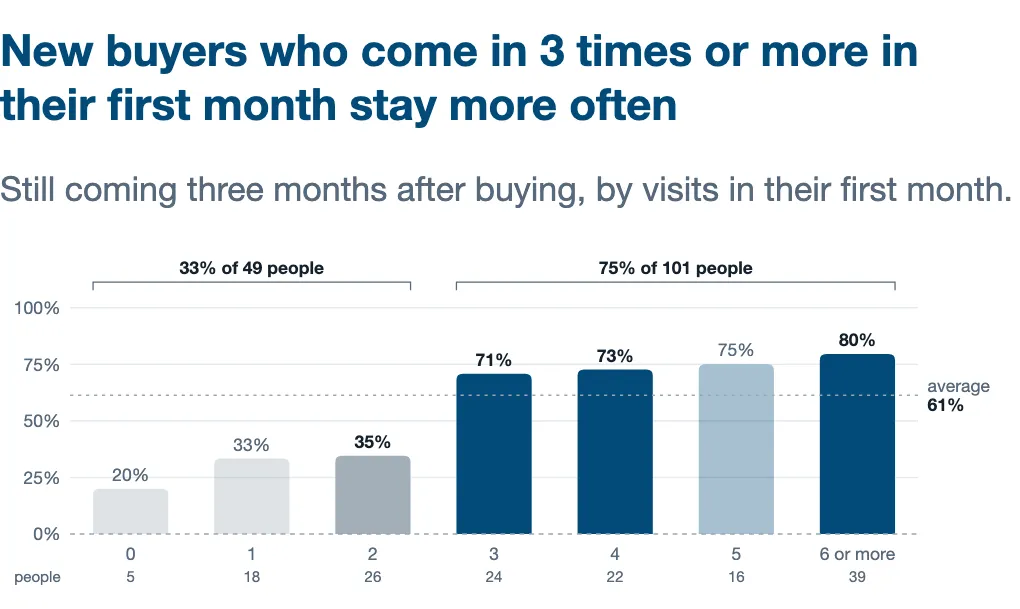
There’s often a number of visits in the first month that separates the new clients who stick around from the ones who don’t. I’ve written about finding your studio’s aha moment separately and the last of the sample pages further down shows what it looks like on a made-up studio.
Community is people knowing each other
When owners talk about community they usually mean clients knowing each other’s names and someone noticing if they stopped turning up.
Most of this comes from regular classes doing what they do. The 6am crowd that’s been together for a year has its own in-jokes. What you can add is small: an instructor who introduces two clients who always end up on neighbouring reformers or a class time that stays on the timetable long enough for a group to form around it.
Notice the people who are thriving
This gets missed because nothing goes wrong if you skip it. A client coming up to their 100th class or a newer client who’s suddenly in three times a week doesn’t need anything from you, so a word from you comes as a nice surprise.
A pilates studio owner I caught up with in June wanted to know when someone came in five times in a week instead of their usual four, so she could send them a personal note saying they’re doing really well. One of the first owners I worked with asked me for milestone alerts early on.
Keep it to recognition and a quick congratulations. A long message about what 100 classes must have meant to someone reads as a tribute and you don’t know what it took them. Something like:
Hey Lena, heads up that your next class is your 100th with us. Congrats!
Better still, say it at the class. Catching someone a few classes before the milestone gives you the chance to do that.
Worked example: Riverside, a demo studio
These are three of Riverside's clients as they stood on 14 October. The clients and visits are invented.
| Client | Started | Worth a word for |
|---|---|---|
| Lena | June 2025 | Next class is her 100th |
| Henry | Feb 2025 | 70 weeks without missing one |
| Owen | June 2026 | In every week since he started |
Lena has been in 5 times in the last fortnight against her usual 2 or 3, so her 100th is probably this week. Owen is the newer client to look at: he came 8 times in his first month, settled on Thursdays and hasn't missed a week in the 16 since he started.
Riverside had 7 clients within three classes of a 50th or 100th that week.
What a points or rewards scheme gets you
A points card or a 10th-class-free deal pays your regulars a discount for coming in when they were mostly coming anyway. It costs you margin on your best clients and everyone gets the same thing, so it says nothing about the person holding it. It can give a new client a small reason to book their next few classes and that’s the use I’d keep it for, if you want one at all.
Recognition costs nothing and it’s specific to them. “Your next one’s your 100th” or “you haven’t missed a week since June” is something only your studio can say to that person.
Where Studio Signal comes in
By hand this is a weekly look at who started in the last month and who’s close to a milestone or on a run. Then it’s two or three short notes and a record of who you’ve written to.
Studio Signal’s Community tab keeps that list for you. It shows who’s a few classes off a milestone and who’s been in every week for a while. It can also write the congratulations for you to send. Anyone flagged as likely to leave is kept off it, so nobody gets a congratulations they’d find odd. Once your studio has enough history, the New buyers list on the Upsell & Conversion tab shows everyone who bought after their intro in the last month, with the ones behind your studio’s own first-month number at the top.